Real-Time AQI Workout Guide : Optimize Outdoor Training
Introduction
Real-time AQI workout planning is the fastest way for fitness enthusiasts to protect lungs while chasing personal bests. By checking the Air Quality Index the moment you lace up, you can decide whether to sprint, jog, or switch indoors, keeping performance high and health risks low. This guide shows how hyper-local data, forecast trends, pollutant-specific exercise choices, and smart alerts turn every run, bike ride, or HIIT session into a safer, more effective workout.
Micro-Adjusting Workout Zones Using Hyper-Local AQI Hotspots
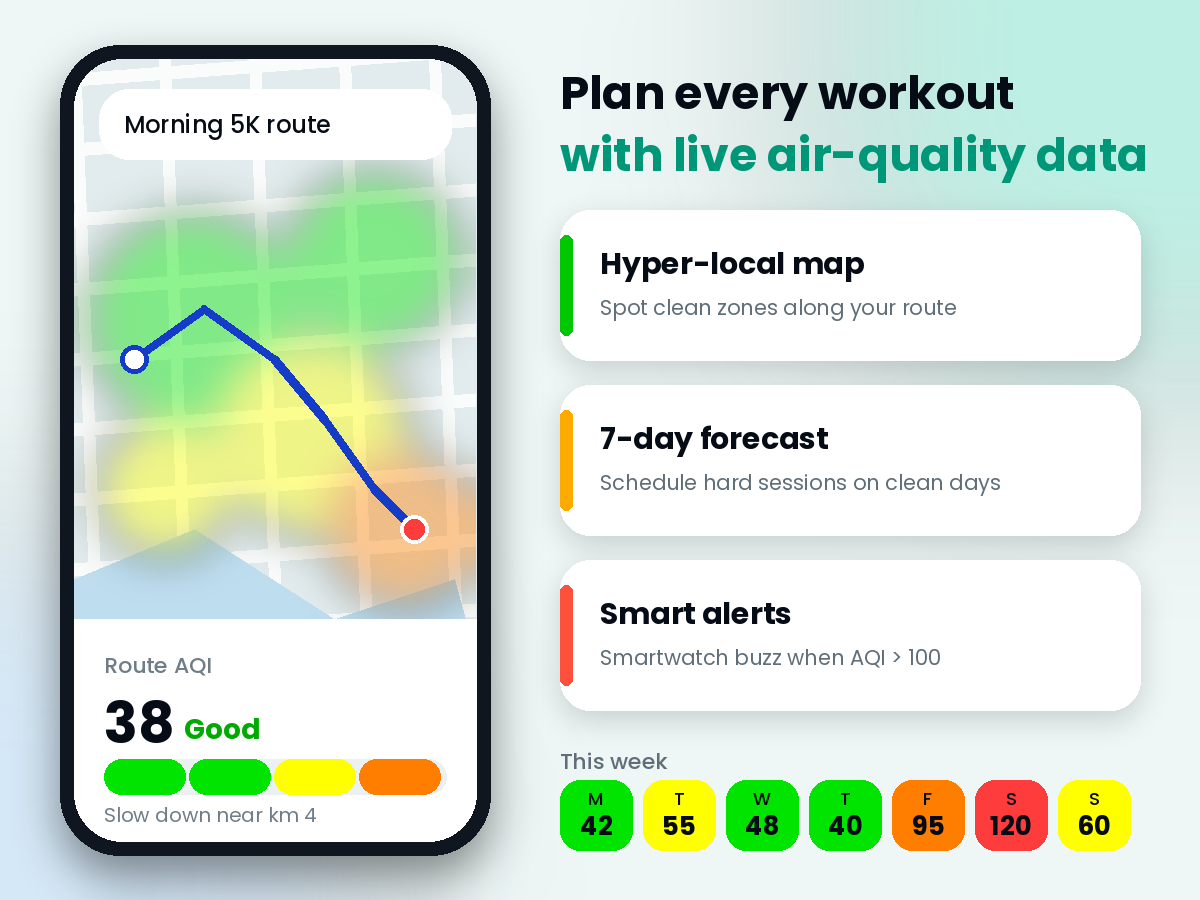
The answer is simple: use street-level AQI readings to carve out cleaner micro-zones within a single route. Modern monitoring grids now deliver data at the block level, so a 5-kilometer loop can contain pockets of “good” air surrounded by “moderate” or “unhealthy” zones.
- Map the route on a live AQI platform - open the map view, zoom to street detail, and note color-coded hotspots.
- Identify transition points - locate intersections where the AQI shifts from green to orange.
- Adjust pace or intensity - speed up on clean segments, then drop to a walk or jog as you enter a higher-pollution stretch.
Concrete example: A runner in Los Angeles follows a coastal path that drops from an AQI of 55 (moderate) near the harbor to 85 (unhealthy for sensitive groups) near a highway overpass. By sprinting the first 2 km and then switching to a brisk walk for the next 500 m, the athlete reduces inhaled particulate matter by roughly 30 % while still covering the intended distance.
Why act now? The cumulative exposure difference between a steady pace and a micro-adjusted one can mean the difference between a post-run cough and a clean recovery, especially for those with asthma or training at altitude.
[!TIP] Use the AQI - Air Quality Index app’s “live map” feature to pinpoint hotspots before you start, then save the route for repeat use.
Leveraging Forecasted AQI Trends to Schedule Weekly Training Plans
Answer-first: Plan your weekly calendar around predicted AQI windows, not just daily snapshots. Forecast models provide 24-hour and 7-day outlooks, letting you align high-intensity sessions with the cleanest air windows.
- Monday-Wednesday (morning): In many midsummer cities, overnight cooling lowers particulate levels, making early-morning runs ideal.
- Thursday (mid-day): Forecasts often show a midday spike from traffic; schedule a strength-training or indoor yoga session instead.
- Weekend (evening): Evening breezes can disperse pollutants, perfect for a longer bike ride.
Concrete example: A cyclist in Delhi checks the 7-day AQI forecast on Tuesday and sees a projected dip to 40 (good) on Thursday evening. By shifting a planned 40-km ride from Saturday afternoon (forecast AQI 120, unhealthy) to Thursday evening, the rider avoids a 50 % increase in inhaled PM2.5 while still meeting mileage goals.
Reason to act: Forecast-based scheduling prevents the need for last-minute cancellations, keeping training consistency high and motivation intact.
Choosing Exercise Types for Specific Pollutant Profiles
The answer: Match the dominant pollutant to the exercise that minimizes its impact. Different pollutants affect the body in distinct ways, and certain activities expose you to them more than others.
- Ozone (O₃) - Peaks in sunny afternoons and irritates the respiratory tract during high-intensity breathing. Opt for low-impact activities like cycling or brisk walking instead of sprint intervals.
- Particulate Matter (PM2.5/PM10) - Concentrated near traffic corridors; choose trail running or park circuits away from major roads.
- Nitrogen Dioxide (NO₂) - Common in dense urban cores; swimming or indoor rowing eliminates exposure altogether.
Concrete example: A runner in Phoenix notices that forecasted ozone levels exceed 150 ppb on hot afternoons. Switching that session to a shaded treadmill workout reduces ozone inhalation by over 70 % while preserving cardiovascular stimulus.
Why this matters: Tailoring exercise type to pollutant profile preserves training quality and safeguards lung function, especially for athletes training at high volumes.
Using AQI Alerts to Prevent Overtraining on High Pollution Days
Answer-first: Set up real-time AQI alerts to automatically cue rest or low-impact days, avoiding the hidden fatigue that polluted air can cause.
- Configure threshold alerts - define “unhealthy for sensitive groups” (AQI > 100) as a trigger.
- Integrate with your smartwatch - receive vibration or visual alerts as you step outside.
- Link to a recovery protocol - when an alert fires, follow a pre-planned low-intensity routine (e.g., mobility flow, foam rolling).
Concrete example: A triathlete in Melbourne receives a smartwatch alert when the AQI climbs to 115 during a scheduled brick session. The alert prompts a switch to a 30-minute indoor bike, preserving training volume while preventing the extra oxidative stress associated with polluted air.
Reason to act: Overtraining in poor air quality can elevate cortisol, impair immune response, and delay recovery, undermining weeks of hard work.
[!IMPORTANT] Consistently ignoring AQI alerts can lead to chronic inflammation, which is harder to reverse than a single missed workout.
Key Takeaways
- Map hyper-local hotspots and vary intensity within a single route to cut pollutant exposure.
- Use 7-day AQI forecasts to place high-intensity sessions in the cleanest windows.
- Match exercise type to dominant pollutants (ozone → low-impact, PM → off-road).
- Set smartwatch alerts for AQI thresholds and follow a built-in recovery plan on bad-air days.
FAQs
How does real-time AQI affect cardio performance?
Real-time AQI influences oxygen uptake; higher particulate levels reduce lung efficiency, leading to quicker fatigue and lower VO₂ max during the same effort.
Can I sync AQI alerts with my smartwatch for automatic workout adjustments?
Yes. By enabling notifications in the AQI - Air Quality Index app and granting permission to your smartwatch, alerts appear as vibrations or on-screen messages, prompting you to modify or postpone the workout.
What pollutants are most harmful during high-intensity outdoor exercise?
Ozone and fine particulate matter (PM2.5) are the most concerning because they penetrate deep into the lungs when breathing rates are elevated, aggravating airway inflammation.
When is the best time of day to run based on forecasted AQI trends?
Early mornings (5 am-9 am) and late evenings (7 pm-10 pm) typically show the lowest AQI values, especially in cities where traffic peaks midday.
How to modify a training plan when AQI spikes unexpectedly?
Switch to a low-impact indoor activity, reduce intensity by 30-40 %, or shorten the session while maintaining cadence to keep the training stimulus without excessive pollutant exposure.
Conclusion
Integrating real-time AQI workout data into every training decision lets you stay ahead of pollution, protect lung health, and keep performance on track. By micro-adjusting zones, leveraging forecasts, aligning exercise type with pollutant profiles, and using smart alerts, you turn air-quality awareness into a competitive edge.
Call to Action with Real-time Aqi Workout
Ready to Start Using real-time air quality data for every run, bike ride, or HIIT session? AQI - Air Quality Index gives you live maps, forecasts, and smartwatch alerts so you can train smarter, breathe easier, and hit your goals without compromise. Explore the app now.
Further Reading
- Air quality and health - Overview of health impacts from common pollutants.
- EPA Air Quality Index - Official guidance on interpreting AQI values.
- World Health Organization - Ambient air pollution-air-quality-and-health) - Global standards and recommendations.
- National Institute of Environmental Health Sciences - Particulate Matter - Detailed science on PM exposure.
- Harvard T.H. Chan School of Public Health - Exercise and Air Pollution - Research on balancing fitness and air quality.
Download Air Quality Index – it's free
Live AQI, pollutants, weather, AQI map and earthquake alerts on Android and iPhone.